
Renovation starts with removing what no longer serves the space. E Grey Industries provides selective demolition for commercial properties, carefully removing walls, finishes, fixtures, and building systems while protecting the areas that need to remain. Our team coordinates demolition with the broader renovation plan, creating a clean, controlled starting point for the construction that follows.
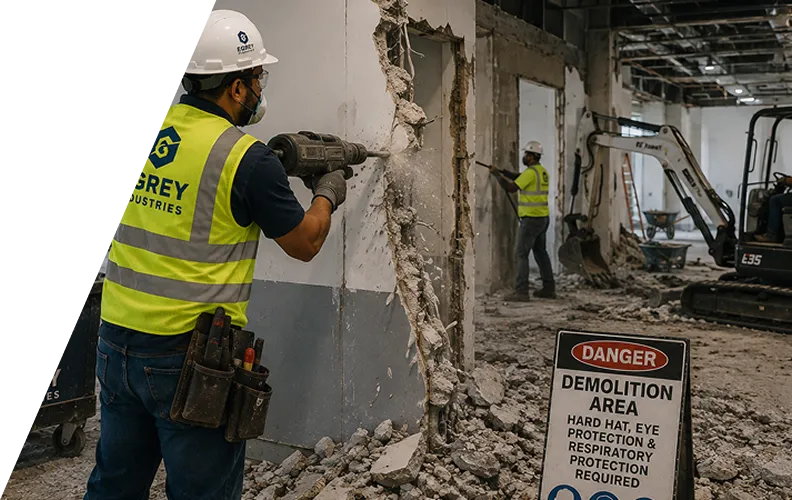
Not every removal project looks alike. Some involve a single floor, while others span an entire occupied building with strict working hours. Our crews adapt their methods to the site, the schedule, and the people still using the space.
Selective demolition is not about tearing a building apart. It is about taking out exactly what the new design calls for and nothing more. Before our crews start, we walk the site, study the drawings, and mark every element scheduled for removal. Load-bearing walls, active utilities, and finishes slated for reuse are identified and protected.
Then the work begins in a controlled sequence. Ceilings come down, partitions are cut back, and outdated mechanical runs are capped and pulled. Dust barriers, negative air machines and floor protection keep debris contained, which matters when tenants or customers occupy the floors nearby.
Once removal is complete, our team walks the space again to confirm every item on the demolition plan has been addressed.
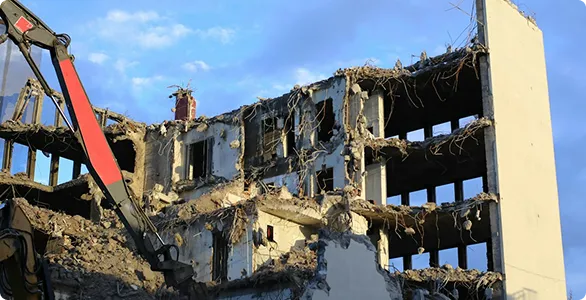
Exposed conditions are documented with photos and notes, giving architects and engineers an accurate picture of what lies behind the old finishes before new work begins. That level of care pays off throughout the rest of the project. Surprises like deteriorated framing, abandoned piping or undersized wiring are flagged early, while there is still time to adjust the design and budget. Owners move forward knowing exactly what they are building on.
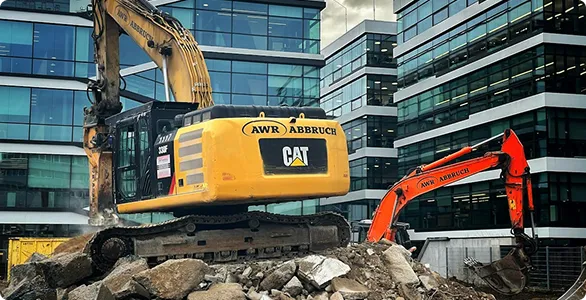
Interior demolition in New York carries real responsibility. Older buildings can hide asbestos, lead paint, or wiring that predates current code, and disturbing them without a plan puts workers and occupants at risk.
E Grey coordinates required surveys and permits before removal begins, working with licensed abatement partners whenever hazardous materials turn up. Our crews follow OSHA safety standards on every shift. Debris is sorted and hauled on a schedule that keeps hallways clear and loading docks available for other deliveries.
Wherever possible, metals and other materials are separated for recycling rather than sent straight to landfill. Because demolition is managed by the same team overseeing the full build, there is no lag between the last load out and the first framing crew in. That continuity shortens the overall schedule and gives owners a smoother path from empty space to finished interior.
Typical selective demolition projects include interior strip-outs, with full removal of finishes, ceilings, and partitions down to the shell; occupied building work, with quiet, contained demolition that keeps neighboring tenants operating; and systems removal, covering safe disconnection and removal of outdated HVAC, plumbing, and electrical.
Controlled removal, planned so the rest of the renovation can start on time.
Our crews have handled interior strip-outs, occupied building work and systems removal, adjusting their methods to each site and the people still using it.
Removal of walls, ceilings and outdated mechanical, plumbing and electrical runs is coordinated with the trades that follow, so framing can start as soon as the space is clear.
Exposed conditions are documented early, so surprises like deteriorated framing or abandoned piping get addressed while there is still time to adjust the design and budget.
Surveys, permits, dust control and OSHA standards are in place before removal starts, with licensed abatement partners brought in when hazardous materials turn up.
The team that removes the old also builds the new, so there is no handoff gap and one group answers for the result.
Tell us what needs to come out and what needs to stay. Our team will plan a removal that sets your project up to succeed.